RPA has seen a steep growth in the last three years. More and more enterprises are welcoming the new age technology that can deliver consistent business value in a short time span compared to large IT transformations. Many leading consulting firms predict that nearly 45%* of traditional business process can be automated with technologies like RPA, OCR(Optical Character Recognition), NLP(Natural Language Processing) , ML(Machine Learning) and AI(Artifical Intelligence).
The Problem?
However, there is a one key common problem with every new technology; i.e. User adoption. To unleash the complete potential of any new technology/product/platform/service one should focus on achieving user adoption, which isn’t an easy task. As people bring in diversity and so variability. This means there would be varied reception and resistance for change expressed by the users(employees) . If organisations don’t account and plan for people and change management, they would fail to achieve the complete benefits of automation even with high quality implementation.
The below equation would represent the effectiveness of any technology
E = Q * A
E = Effectiveness of a technology
Q = Quality of the Technology ( Product, Process selection and Implementation)
A = user Adoption
Let us focus on the “A” part of the equation adoption
Impact
There are two key variants of RPA
- Unattended automation : – Virtual Bots that run on virtual machines without any manual interference. These Bots can be scheduled and managed from a centralised control panel(admin) portal. These are quite prominent in Back office processes – Invoice processing, Reconciliation, Payroll processing etc.
-
- Majority of the unattended automation’s would get triggered with an initial input file, Email or a new ticket which is loaded by a human in the prior step. If the process specialists aren’t trained properly, they wouldn’t streamline to the newer process. This would lead to under utilization or erroneous file uploads.
-
- Most of the Bots would handover complex requests/exceptions to a process specialist. If the process specialist isn’t receptive of the newer approach there could be delays and errors in managing the dropout queue.In turn this could increase the total turn around time.
- Attended Automation : – These are bots that are deployed on a user machine and would be trigger by the user as and when required.(On demand)
-
- Imagine a contact centre with 200 users who are equipped with attended bots that can perform various task while the specialist is on a call with the customer. But, you would a mixed response and varied uptake of automation in the early days which would lead to longer calls and erroneous communication. This would take a proper communication and training strategy to speed up the user uptake.
- This would introduce a high variability in achieving
In case of enterprise automation, the users would be internal – Employees, vendors, contract workers and suppliers who are accustomed to the prevalent and existing business processes. It would need a well-planned approach to break this inertia to successfully navigate through the transformation.
Understanding the users
Users can be categorized in the below way
| User Types | Impact | approach | ||||||||||
| Impacted Users – Enhanced with Automation | Attended automation and Complex tasks would get simplified giving back more time to the specialist allowing them to work on higher value tasks | – Focus on UX while automation process is being designed | – Consider user personas | – Involve and draft a training plan prior to go-live | – Gamification and comparative reporting will motivate them to towards higher adoption. | |||||||
| Impacted Users – Freed up because of Automation | Users that are directly impacted by the introduction of Automation. There would be a substantial reduction in the | – Cross skill and Upskill | – Pre-empt the impacted roles | – Provide opportunities for maintaining and running the RPA bots | – Limit the recruitment to ensure that the freed up workforce is leveraged. | |||||||
| Business Stakeholders | Stake holders that get benefitted with Automation | – Trained on the admin module | – Define KPI’s and reporting structure | – Keep the Business case up to date | – Downstream and Upstream impacts |
Adoption Curve and Approach to handle each of the user categories
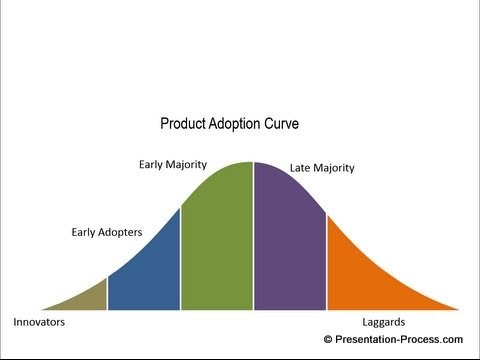
Innovators and Early adopters welcome new technology and will establish synergies.
Late Majority and Laggards: Organisations face challenge with the rest of users in the spectrum. They would be sceptical and would resist the change of technology or newer approaches.
A relative scoring system to be introduced to benchmark and categorise the users. Follow the above mentioned categorisation and approaches to identify and track the automation adoption.
 Automation and AI
Leave a comment